
A commercial laundry robot cannot fold a towel it has never learned to hold.
Just like learning a new language, someone's got to teach you (at least at first).
Before automation reaches the laundry floor, someone has to show a machine how fabric behaves, grasp by grasp. It's like learning a physical language: grab the cloth like this, not like that, when it does that. Here's what you do in this scenario. Here's what happens in that scenario.
Like languages, which almost always have a bevy of unique exceptions to rules and idiosyncrasies that can only be learned via experience over time, a robot has to be trained so it can handle the unpredictability of deformable linen pieces.
That teaching process, not the folding itself, is the engineering problem at the center of Spindle's work with AI robotics partner Acumino. Here is how that work happens, and why the data behind it matters more than any single machine.
Below you can watch Episode 2 of our ongoing series, "Project Fold," in which we offer an inside look at our commercial laundry robotics development process:
(In case you missed it, watch Episode 1 on the challenge of robotic cloth manipulation.)
Why Cloth Manipulation Starts With Data
Cloth manipulation is one of the hardest tasks in robotics, and relatively few teams are seriously attempting it. Feeding linen into machinery and folding it look simple to a human, but they demand judgment that robots do not yet have: how to pick up a limp, shifting piece of fabric, where to grip it, and how to guide it through equipment without bunching or dropping it.
That judgment cannot be hand-coded. It has to be learned from examples. So the first step toward automating commercial laundry is not building a robot at all.
It is capturing, in fine detail, exactly how a skilled person handles linen.
Commercial Laundry Data Collection, One Grasp at a Time
This is where commercial laundry data collection comes in.
Rather than program a robot with rigid rules, the team records human demonstrations using specialized interfaces, then transfers what those demonstrations teach directly to the machine.
The goal is a clean, one-to-one hand-off. Instead of performing a task one way and then painstakingly translating it into robot instructions later, the operator's actions are captured in a form the robot can adopt directly. The person doing the cloth manipulation task is, in effect, writing the robot's training set in real time.
For the robot, that means class is in session.
A Wearable System for One-to-One Skill Transfer
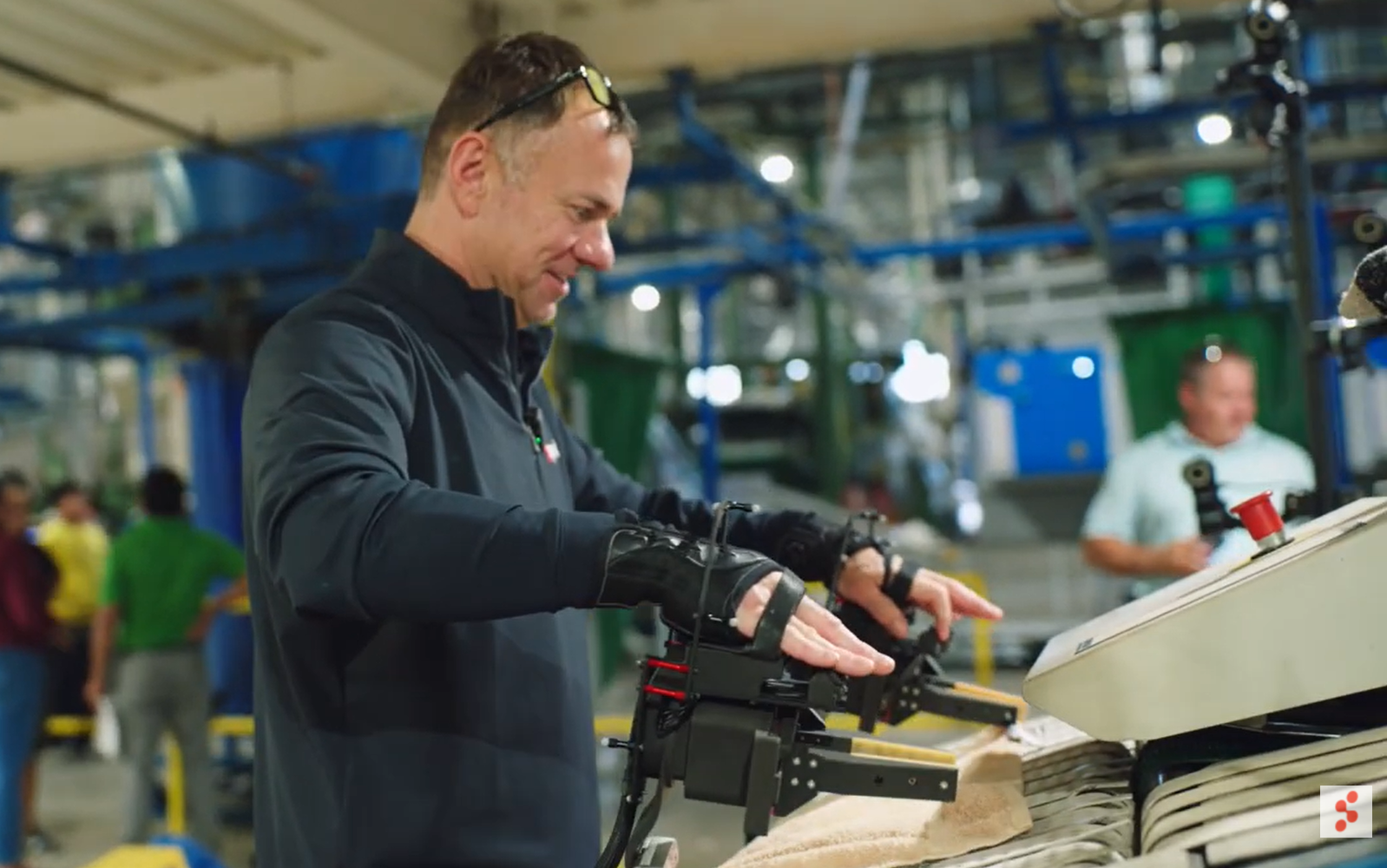
The tool that makes this possible is a wearable system from Acumino. Worn by a human operator, it acts as an extension of the body and can accommodate almost any robotic gripper or hand. That design lets the team teach dexterous tasks on the fly rather than reprogramming the robot for each new job.
The wearable can capture material handling, material deposition, assembly, and other complex activities that people routinely perform in factories. For a laundry, that means the method used to teach towel folding or ironer feeding today can be pointed at the next stubborn task tomorrow.
What Laundry Robotics Data Actually Capture
The value lives in the details of the laundry robotics data itself. As an operator works, the system tracks the key points of the interfaces and records how each piece of linen is handled, like where the towel is grabbed, how it is grabbed, and how heavy it is. All of that information is stored intrinsically with the motion.
For a deformable object, those variables are everything.
A towel has no fixed shape, so grip location, applied force, and weight distribution change from piece to piece. Capturing them turns an unpredictable human skill into structured data a robot can learn from, which is the foundation any reliable laundry automation has to stand on.
R&D in the Real World
None of this is frictionless, and Spindle is candid about that. During a recent session, an automated machine hit an equipment snag mid-task. Rather than stop, the team pivoted to dry folding by hand and kept the work moving.
That moment is a fair picture of where the technology stands. Building robots for one of the toughest environments in the industry is slow, deliberate work, full of hardware hiccups and on-the-spot adjustments. Being honest about the messy middle is part of doing it right.
The Spindle and Acumino Partnership
Acumino supplies the physical-AI and skill-transfer technology, and Spindle brings deep knowledge of the commercial laundry market. Acumino has been direct about why that pairing matters: Spindle understands the industry, holds long-standing relationships with its key players, and knows which tasks need automating and how.
The team is equally honest about timing. A commercially viable speed may or may not arrive within a year, but Acumino expects the partnership to reach it inside roughly two. For an industry that has long assumed cloth handling was too hard to automate, seeing it work on a real laundry floor would be a genuine milestone, and the data being gathered now is what will get it there.