
Modern robots can weld, palletize, and assemble with millimeter precision, yet feeding a limp napkin into an ironer still stops most of them cold. That paradox is one of the toughest problems in commercial laundry robotics, and it is exactly the problem Spindle set out to solve.
You can watch Episode 1 of our ongoing series, "Project Fold," below:
Why is cloth so hard for machines to handle? The answer is relatively simple, yet complex at the same time.
Commercial Laundry Labor Costs Set the Agenda
It all starts with a problem every operator knows too well.
Stop us if you've heard this one before: Laundries are facing a chronic labor shortage, and the cost of labor has been a challenge for a very long time.
Spindle has spent years helping plants address it, but a surprising amount of work still depends on people: feeding towels and napkins into ironers, hanging shirts and pants at sort, and other repetitive jobs that have proven very difficult to automate.
So Spindle asked a sharper question.
Instead of chasing the easy wins, the team looked at what has not yet been automated in commercial laundries, and why those specific tasks have resisted every attempt. For context, industry figures reported by American Laundry News show the stakes: a typical laundry employee can sort, fold and stack roughly 120 pieces an hour by hand, while automated systems can reach many times that.
When labor is scarce and expensive, the tasks machines cannot yet do become the real bottleneck.
The Deformable-Object Problem: Why Cloth Defeats Robots
The answer comes down to physics.
Rigid parts hold their shape, so a robot can memorize one motion and repeat it. Cloth does the opposite. As Acumino's team puts it, deformable objects are especially hard because they bend out of the plane, change under contact forces, and settle into shapes that are almost impossible to predict.
Feeding a napkin into an ironer looks trivial to a human, but it is a highly variable, complex task for a machine. There is no fixed geometry and no single correct way to grip. Every pick is a little different, which is exactly what breaks conventional "pick and place" programming.
Building a Dexterity Map
Spindle's approach starts by studying the task, not the robot. For each job, the team builds a dexterity map: a catalog of the different ways a task can be performed and how difficult each variation is.
A simple analogy captures the essence of what is happening here. ask several people to open a bottle and each will do it a little differently.
From that map, the team looks for the simplest reliable method that suits the gripper. If a task proves dependable from the first day of data collection, little more is needed. If variability is high, the work shifts to gathering more data and feedback until the system becomes consistent. The right amount of effort depends entirely on the task.
Capturing Human Skill, One Gripper at a Time
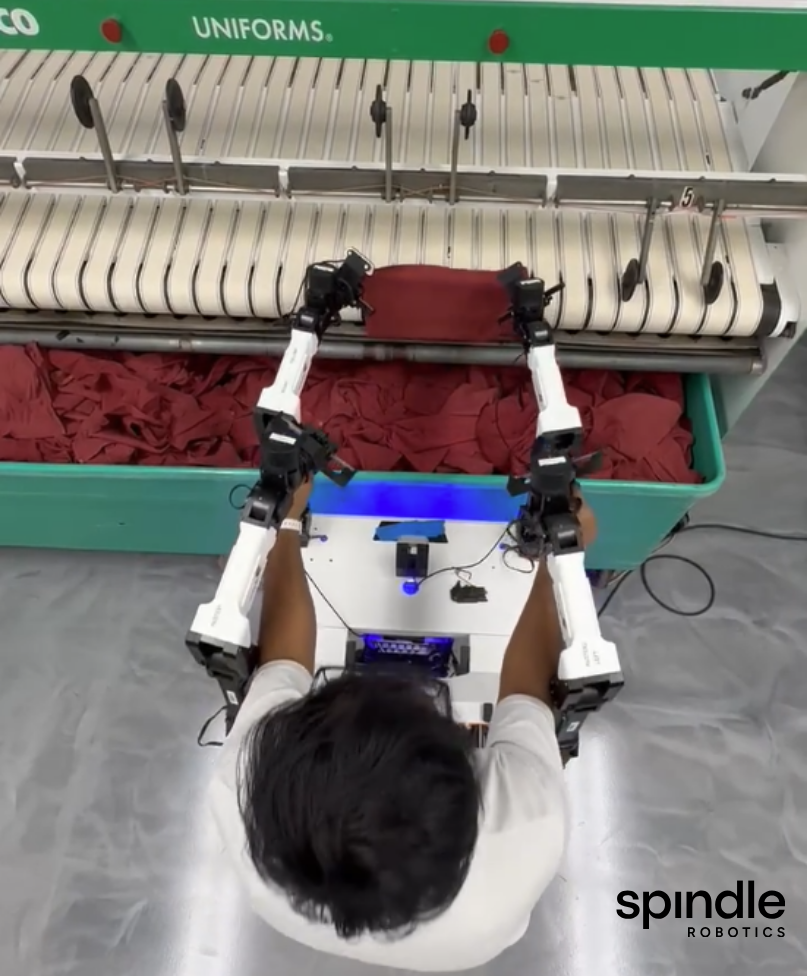
The most striking part of the approach is how the data is captured. Rather than recording a person's bare hands or a stand-in tool, the team collects data with the very same gripper that will later mount on the robot arm. Operators drive the gripper's fingers with joystick controls, starting and stopping recordings as they work, while the system tracks markers that represent the object being handled.
This human-to-robot skill transfer captures the messy, real-world dynamics of fabric that a spec sheet never could. Behavior can shift once a motion moves to the robot, with material sliding differently than it did in training. Encoding those dynamics into the data is the whole point.
In other words, the process of transferring a human skill we take for granted to a robot arm can be a bit like ordered messiness. More data helps move the process down the order-mess continuum ... in other words, more — and better — helps make for a more ordered process, one in which a robot arm can more effectively simulate the gripping action that a human employee does with reached for deformable objects.
Finding the Right Commercial Laundry Robotics Partner
Spindle did not try to build this alone. When the company first moved into robotics, key team members spent four or five days walking the floors of major robotics trade shows such as Automate, taking prolific notes and holding long conversations with robotic-arm makers, computer-vision providers, and software developers.
The conclusion came quickly: success would depend on finding the right partner.
That partner is Acumino, a physical-AI company led by CEO and CTO Minas Liarokapis. Acumino builds hardware-agnostic AI models that aim to make robots as dexterous as humans and useful in production today. Its focus on deformable-object manipulation, captured through data-driven training, maps directly onto the laundry problem. The two companies have paired Acumino's AI and skill-transfer technology with Spindle's deep laundry expertise and established robotics platforms.
What It Means for Commercial Laundry Automation
The goal of this commercial laundry automation work is simple: to hand the stubborn, injury-prone tasks to machines so teams can focus on higher-value work, easing both labor shortages and rising costs.
The honest takeaway, however, is that the problem is not fully solved. Liarokapis has framed the central unknown as whether a single system can handle the immense variety of textiles in a real laundry, especially from a robotic perception standpoint.
But the path is now visible. By mapping dexterity task by task and training AI on how fabric truly behaves, Spindle and Acumino are turning the hardest problem in robotics into a practical roadmap for the plant floor.
Interested in learning more about our robotics offerings? Request a demo to see it for yourself.