

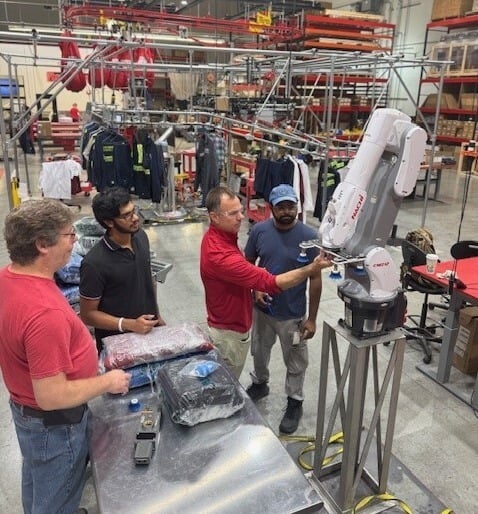
For commercial laundry leaders, automation has shifted from a "someday" conversation to a present-day operating decision.
The future is now, is what we're saying.
It's an exciting time to be in the commercial laundry industry, but it does mean that managers and the C-suite need to keep up to date on the next wave of technological advancements.
The pressures you might be feeling are familiar to us, having served the industry for decades: a shrinking labor pool, rising costs, and higher expectations from the accounts you serve.
TRSA, has documented that many laundries now face significant labor shortages marked by high turnover and fierce competition for staff that drives up wage and administrative costs, which it identifies as a core reason robotics is drawing serious attention on the finishing side of the plant (TRSA, "Laundry 'Cobots': A Potential Laborsaving Breakthrough").
Robotics can be a powerful answer to that pressure, but only when it's approached deliberately. On top of that, every operation is different, from size to financials and everything in between. What might work for one laundry might be totally unsuitable for another.
In other words, what problem would a new robotic element be solving for you? We don't believe in adding things for the sake of it. Everything should have a purpose.
In this article, we'll review:
Here are five things to think through before you automate.
1. Start with the problem, not the robot
The temptation is to ask "what can we automate?" The better question is "where is uncertainty hurting us most?"
A modern laundry works best as a combination of people and robotics moving toward a single goal: reducing uncertainty on the plant floor. Automating repetitive tasks reduces human error and frees your team for higher-value work. That is exactly how you take the fight to the bottlenecks that slow everything down, particularly amid rising labor costs and labor shortages.
Anchor your automation decision to a specific, recurring pain point — for example, soil-sort hanging, packout transport, feeding, palletizing — rather than a general desire to "add robots." The clearer the problem, the clearer the payback.
Think about when you go to buy a car. The goal isn't always to buy what might be considered the nicest or fanciest car on the market. Every person has specific needs. One person might value gas mileage. Another person might want more towing capacity. Another person might want a bigger vehicle that fits a large family. Just like you'd walk into a car dealership with a list of must-haves and nice-to-haves, you should consider what works best for you plant.
2. Make sure it fits the plant you already have
One of the fastest ways an automation project stalls is by demanding changes to your building, your machinery, or your footprint. Look for solutions designed to integrate into your existing infrastructure without requiring changes to the plant's footprint, and that are vendor-agnostic by design—working with your current machinery to enhance operations rather than replace them.
This matters most in mixed equipment environments. A machine-agnostic approach means the same automation can integrate with the equipment you run today, protecting the capital you've already invested and shortening the path to a working deployment.
3. Protect your people ... safety is a system, not a spec sheet
Automation should make the floor safer, not introduce new hazards.
Collaborative robots, or cobots, are built with power-and-force-limiting and separation-monitoring features that let them share a workspace with people. That is precisely the kind of design that can take on the repetitive, injury-prone tasks that slow teams down while creating a safer environment for higher-value work.
Ultimately, we believe that's what automation should do.
Those built-in features are necessary but not sufficient. Peer-reviewed analysis of workplace robot incidents found that ergonomics-related injuries and sensor or signal communication errors are among the recurring archetypes of human-robot injury, underscoring that safe deployment depends on the surrounding workspace design as much as the machine itself (Sanders et al., Applied Ergonomics, 2024).
The recognized technical baseline for this is the international standard ISO/TS 15066, which defines the collaboration modes—speed and separation monitoring, and power and force limiting—that govern safe human-robot interaction (ISO/TS 15066:2016).
Ask any vendor how their solution addresses this standard and how it meets applicable safety guidance for your workforce. They should be able to provide you with a clear answer that can be applied directly to your workplace environment. Clarity is the foundation for a safe workplace environment.
4. Choose the right fit, not just any fit
Robotics is not a shelf product. The most costly mistake is buying hardware that technically works but was never validated against real laundry conditions. Effective solutions are the result of rigorous research, development, and deep industry insight. The outcome of evaluating vendors, testing technologies, and working alongside laundries so that each product solves a real-world challenge, from sourcing the right end-effectors to integrating robotics with specific machine applications, is a solution that just works for you.
Whether you already have a solution in mind or are just beginning, the goal is the same: ensure it's the right fit, not just any fit. A partner with laundry-specific integration experience can spare you the expensive trial-and-error of proving that out on your own floor.
5. Build the data foundation first and let it guide your capital
If you're familiar with our journey over the years, there's been one consistent throughline: consistent, accurate data is the foundation of all informed decisions.
Robotics delivers its best return when it sits on top of a plant that already understands itself. Before you invest, it's worth asking the better question: are you truly maxing out what you already have?
Visibility into actual capacity, idle time, and causes of downtime lets you decide whether to optimize existing assets, shift equipment between locations, or invest in new infrastructure only when it's genuinely needed.
That same data foundation is what makes intelligent automation possible in the first place. Unlocking AI in your plant starts with real-time, reliable data from every corner of your operation—the groundwork for automation that is actually custom-fit to your workflows, from tunnel loads to press times to production variability.
Automate a process you can't yet measure, and you're automating a guess. We don't believe in guesswork.
The bottom line
Robotics rewards laundries that treat it as an operational decision rather than a purchase.
Define the problem, respect the plant you already run, put worker safety at the center, insist on a right-fit solution, and build on a foundation of reliable data. Get those five things right, and automation stops being a leap of faith. Automation should be a lever you can pull with confidence.
If you want to read a little more on the subject of automation in commercial laundries (and AI), we have a chapter on that – and much more – in our guidebook, "Learning Laundry: An Intro to Commercial Laundry Operations."
As always, if you have any feedback about the book, you can always reach out to us to share any thoughts you may have about material you want to see in future editions of the guidebook. We want it to be a resource for you.